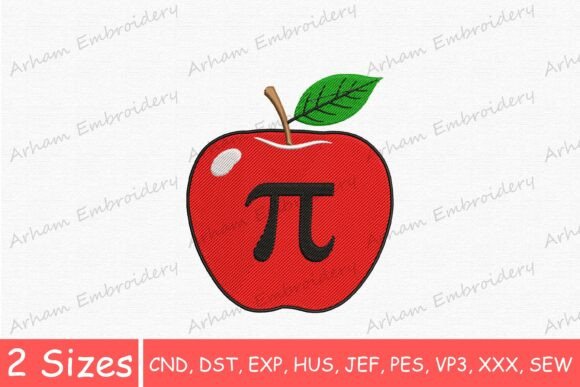
Red Apple with Pi Embroidery
A Craft Fair Designer’s First Look: Bold, Brainy, and Booth-Ready
As someone who’s stitched 300+ craft fair seasons—and curated booth displays for math teachers, STEM boutiques, and back-to-school pop-ups—I’ll say it straight: Red Apple with Pi Embroidery lands with quiet confidence. It’s not loud or cartoonish; it’s cleverly minimal—clean lines, intentional spacing, and that subtle wit only educators and number lovers instantly recognize. First impression? Modern academic charm: part classroom staple, part handmade sophistication. It reads as premium without being stiff—ideal for small shop products aiming to stand out beside rustic florals or vintage typography.
Where This Machine Embroidery Design Shines In Real Displays
At a crowded craft fair, attention spans are short and hands reach fast. Here’s where Red Apple with Pi Embroidery earns its spot:
- Tote bags: Centered on natural canvas or oatmeal linen, it reads clearly from six feet away—no squinting. The apple shape anchors the design; the π symbol adds just enough intrigue to draw curious buyers (“Wait—is that pi?!”).
- Aprons: Perfect above the pocket or centered on the bib. Its balanced proportions avoid visual clutter—critical when paired with chalkboard-style embroidery or hand-stitched pockets.
- Tea towel embroidery: Works beautifully on medium-weight cotton towels. The design doesn’t drown in texture, and the clean apple outline holds up even with slight fabric puckering.
- Embroidered patches: A standout small shop product. Stitched onto denim jackets or backpacks, it signals identity—not just “I teach,” but “I love the elegance of math.”
- Pillow covers & fabric pouches: Scales down gracefully. At 3–4 inches wide, the π remains legible, and the apple retains its friendly silhouette—unlike overly detailed STEM motifs that blur at smaller sizes.
It falters only where clarity is compromised: curved cap surfaces (unless digitized specifically for headwear), ultra-thick terry cloth towels, or dark fabrics without high-contrast thread colors. More on that below.
Production Reality Check: What Makes This Design Sellable—And What Requires Care
This isn’t just about aesthetics—it’s about batch efficiency, consistency, and buyer trust. As an embroidery designer, I ask three things before committing to 50 tote bags: Is it instantly readable? Does it scale reliably? And does it photograph like it feels in person?
Red Apple with Pi Embroidery passes all three—but with caveats. Its strength lies in simplicity: no gradients, no micro-details, no overlapping satin stitches that trap lint or snag threads. That means lower stitch density, faster run times, and fewer thread breaks during commercial embroidery runs. For Etsy sellers juggling orders alongside family life, that’s real time saved.
But here’s what demands attention:
- Tiny lettering or fine π lines: If the symbol renders thinner than 0.8mm in the embroidery file, test it on scrap fabric first—especially with matte thread or low-luster cotton. On textured tea towels, fine details can disappear.
- Dark fabric compatibility: This design leans into contrast. On navy or charcoal, use bright white or lemon-yellow thread—not ecru or light gray—to preserve legibility.
- Hoop size & stabilizer needs: While compact, ensure the file fits standard 4×4 or 5×7 hoops. Use cutaway stabilizer for knits or stretchy apron fabrics; tear-away works well for stable cotton totes and pillow covers.
- Fabric texture interference: Avoid dense terry, heavy burlap, or heavily brushed fleece unless you’ve tested stitch penetration and topstitch clarity.
Booth Impact & Buyer Psychology: Why This Design Converts
In my experience, Red Apple with Pi Embroidery sparks conversation—not just “cute,” but “Oh! My daughter’s algebra teacher would love this.” That’s gold at a craft fair. It bridges personal meaning (teacher pride, student nostalgia, STEM advocacy) with tactile quality. When stitched cleanly on a heavyweight market bag, it elevates perceived value—customers pay more for items that feel intentional, not mass-produced.
For boutique makers building brand consistency, this design supports a cohesive aesthetic: think neutral palettes, linen blends, and minimalist packaging. It pairs seamlessly with other School-themed embroidery files—like chalk-dust icons or geometric protractor motifs—without visual competition.
And online? It photographs exceptionally well. Clean background, soft lighting, and one real mockup (not just a printable mockup) will boost Etsy conversion. Buyers scroll fast—this design stops them because it’s both familiar and refreshingly specific.
Designer Notes You Can’t Skip Before Production
Before stitching your first batch of Red Apple with Pi Embroidery products, do these five things:
- Test on scrap fabric—matching your final product’s weight and weave. Check for pull, shadowing, or thread nesting.
- Verify thread contrast against your base fabric. Print a swatch if unsure—what looks sharp on screen may vanish on oatmeal linen.
- Review spacing and alignment in your embroidery software. Ensure the apple and π sit in harmonious proportion—not cramped, not floating.
- Confirm hoop size and commercial licensing. If selling finished products (not just the digital embroidery file), verify the license permits commercial embroidery use. Don’t assume.
- Create at least one physical mockup—stitched, pressed, and styled on your intended product. A photo of that real item beats ten digital renderings.
The Bottom Line for Creative Entrepreneurs
Red Apple with Pi Embroidery isn’t just another back-to-school trend. It’s a quietly strategic craft fair product—scalable, emotionally resonant, and production-smart. It performs across categories without demanding specialty equipment or endless troubleshooting. For embroidery business owners, Etsy sellers, and handmade shop owners building a niche in education-adjacent markets, it’s a rare balance: smart enough for teachers, warm enough for gift buyers, and clean enough for modern home goods. Just remember: respect the details, test before you batch, and let the design speak for itself—because in a sea of handmade, Red Apple with Pi Embroidery doesn’t shout. It invites.