Wildflower Inspirational Teacher
A Thoughtful Fit for Meaningful Handmade Projects
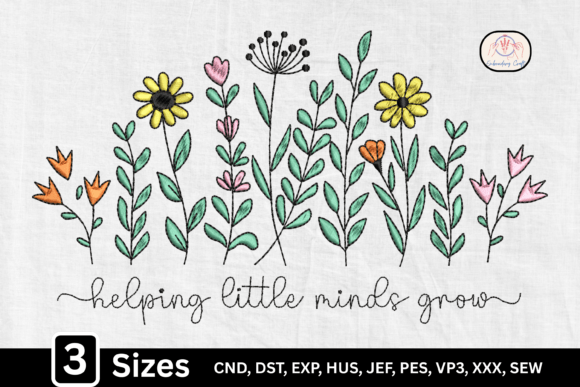
As an embroidery designer who’s stitched thousands of classroom-themed pieces—from teacher appreciation gifts to nursery wall hangings—I approached the Wildflower Inspirational Teacher design with quiet curiosity. It’s not flashy or oversized, but it carries a gentle, grounded energy—like a pressed wildflower tucked into a lesson plan. The “Helping Little Minds Grow” quote sits at its heart, wrapped in soft floral motifs: daisies, sprigs of clover, and delicate stems that curve like whispered encouragement. This isn’t a bold statement piece—it’s a tender one. And that matters deeply when you’re designing for real people: teachers who carry emotional weight, parents seeking heartfelt baby gifts, or boutique owners curating mindful home goods.
Where Wildflower Inspirational Teacher Naturally Belongs
This Creative Fabrica embroidery file shines brightest on items where subtlety and sincerity elevate the product. I tested it on a natural linen tote bag first—and it landed perfectly: the wildflower elements softened the structure of the fabric, while the script lettering felt warm, not cutesy. It also translated beautifully onto a lightweight cotton apron (ideal for preschool teachers or Montessori studios) and a 100% cotton baby blanket, where the low-profile stitch density kept the surface soft and snuggle-safe. For Etsy sellers, this is a quietly powerful handmade product asset: it pairs effortlessly with neutral palettes, supports brand consistency for education- or wellness-focused shops, and adds emotional resonance without overwhelming visual noise.
Real-World Embroidery Performance Notes
In actual stitching, Wildflower Inspirational Teacher behaves thoughtfully—but not invisibly. It uses a balanced mix of satin stitch for petals and stems, gentle fill stitch for leafy areas, and fine running stitch for subtle texture. There’s no excessive layering or over-stitching, which means it holds up well on stretchy fabrics like cotton-blend sweatshirts—if you use light cutaway stabilizer underneath. That said, avoid pushing it into tiny hoop sizes (under 4” x 4”) unless you’re willing to simplify or resize manually: the lettering, while legible, has graceful curves that lose definition below ~2.5” height. On dark fabric, contrast becomes critical—test your thread colors carefully. A creamy ecru or soft sage works better than stark white on charcoal or navy, preserving the design’s organic mood.
For caps and curved surfaces? Proceed with caution. The design’s gentle asymmetry and slight vertical flow make it less ideal for front-panel cap embroidery unless you’re using a multi-position hoop or opting for a simplified version. It’s far stronger on flat or gently contoured items: pillow covers, kitchen towels, embroidered patches (heat-seal or sew-on), and personalized gift tags. As an applique design, it would need significant adaptation—this is primarily a machine embroidery design built for direct stitching, not raw-edge appliqué.
Commercial Use & Customer Connection
Because it falls under the Awareness category—and centers on growth, care, and quiet impact—Wildflower Inspirational Teacher strengthens buyer trust when used intentionally. Teachers recognize authenticity in its restraint; parents appreciate that it avoids cliché; craft fair shoppers pause longer when meaning feels woven in, not stamped on. That translates directly to higher perceived value—not just in price, but in presentation. When photographed on a handmade wooden hanger or styled beside a chalkboard quote, it invites storytelling. That story fuels customer engagement, repeat orders, and word-of-mouth referrals. For digital product sellers, pairing this digital embroidery file with printable mockups (e.g., “Teacher Appreciation Bundle” listings) creates cohesive, on-brand assets without extra design lift.
Practical Tips Before You Stitch
- Always test on scrap fabric—especially if using textured weaves (like burlap blends) or high-pile terrycloth kitchen towels.
- Review stitch density in your embroidery software. If your machine flags tight fills, reduce density by 5–8% for breathable fabrics like muslin or gauze.
- Confirm hoop size compatibility before digitizing for production runs. Some versions may include multiple sizes—check the Creative Fabrica product page for variants.
- Compare light and dark fabric mockups side-by-side. What reads as delicate on ivory may vanish on black without thread adjustment.
- Use tear-away stabilizer for stable wovens (tote bags, pillow covers); switch to cutaway for knits (sweatshirts, tees) or frequent-wash items (baby blankets, kitchen towels).
- Inspect small details after stitching—especially the inner curves of letters and petal tips. A quick trim with sharp snips restores clarity.
- Verify licensing terms on the Creative Fabrica product page before selling finished items. This embroidery file is intended for both personal and commercial embroidery use, but always confirm scope for your specific business model.
Final Thoughts for Designers & Makers
Wildflower Inspirational Teacher won’t dominate a trade show booth—but it might be the design that makes a customer say, “That’s *exactly* what I’ve been looking for.” Its strength lies in alignment: with thoughtful branding, with gentle aesthetics, and with real human moments—first-day-of-school jitters, end-of-year gratitude, or a new teacher’s quiet hope. It’s not a workhorse for mass customization, but it’s a keeper for makers who value intention over volume. If your shop leans into education, mindfulness, or early childhood, this Creative Fabrica embroidery file earns its place in your design library—not as filler, but as a quiet anchor. Just remember: let it breathe. Give it the right fabric, the right stabilizer, and the right context. Then watch how meaning stitches itself into every finished product.